 Skip-the-line available
 A Sicily Itinerary That Does the Valley of the Temples Properly
Most Sicily routes give Agrigento two hours at noon. Here is a Palermo-to-Catania plan that gives it an evening, a morning and the white cliffs — without losing the rest of the island.
There is a standard shape to the week-long Sicily itinerary, and it quietly ruins its own best day. Palermo at one end, Catania or Syracuse at the other, and somewhere in the middle a coach or hire car swings through Agrigento at half past twelve, walks the Valley of the Temples in the very hottest and most crowded ninety minutes of the day, and drives on. The greatest ensemble of Greek temples outside Greece — a UNESCO World Heritage property since 1997 — gets treated as a photo stop. The fix costs nothing but a route decision: sleep in Agrigento. One overnight converts the drive-by into an evening among floodlit temples, a cool solo morning on the ridge, the Kolymbethra Garden, the museum's stone giant and the white marl staircase of Scala dei Turchi. This guide builds the full route around that decision, with compressed and reversed variants.
The two-hour mistake
Start with why the drive-by fails. The archaeological park at Agrigento is not a monument you glance at; it is a 1,300-hectare landscape — the largest archaeological park in Europe — whose headline temples alone line 1.3 kilometres of exposed ridge. The UNESCO inscription covers 934 hectares of temples, ancient walls, necropolises and the farmland between them, much of the ancient city still lying unexcavated under the orchards. Walking it properly takes two to three hours before you have so much as considered the museum. Arriving at midday in July, you meet all of that at 35 degrees, in the glare that flattens the stone, alongside every coach party on the island.
Now count what the midday visitor never sees. The morning ridge at 08:30, when the light is low and the site is nearly private. The evening ridge in summer, when the park's night openings keep the gates open long after dark — in 2026, from 20 June to 20 September, with entry until 22:00 on weekdays and 23:00 on weekends — and the temples stand floodlit against the night sky. The Kolymbethra Garden in the cool of the late afternoon. The Telamon colossus in the archaeological museum. Scala dei Turchi at golden hour. Every one of these belongs to the traveller who sleeps in Agrigento, and none to the one who drives through it.
The route logic favours the overnight anyway. Agrigento sits at the midpoint of Sicily's southern coast: around two hours' drive from Palermo, and positioned so that the eastward continuation toward Piazza Armerina, Syracuse and Catania is a natural progression rather than a backtrack. An Agrigento night is not a detour from the standard Sicily route — it is the standard route, done at the correct tempo.
Days one to three: Palermo, then the road south
Give Palermo two nights. The capital rewards them — the Norman palaces and mosaics, the markets, the street food, an evening in the centro storico — and it positions you to collect a hire car on the morning of day three and drive south across the interior. The Palermo–Agrigento leg takes around two hours by the direct road, through the wheat-coloured hill country that most coastal itineraries never touch. Leave Palermo after breakfast, and you are checking in at Agrigento by early afternoon with the whole evening in hand.
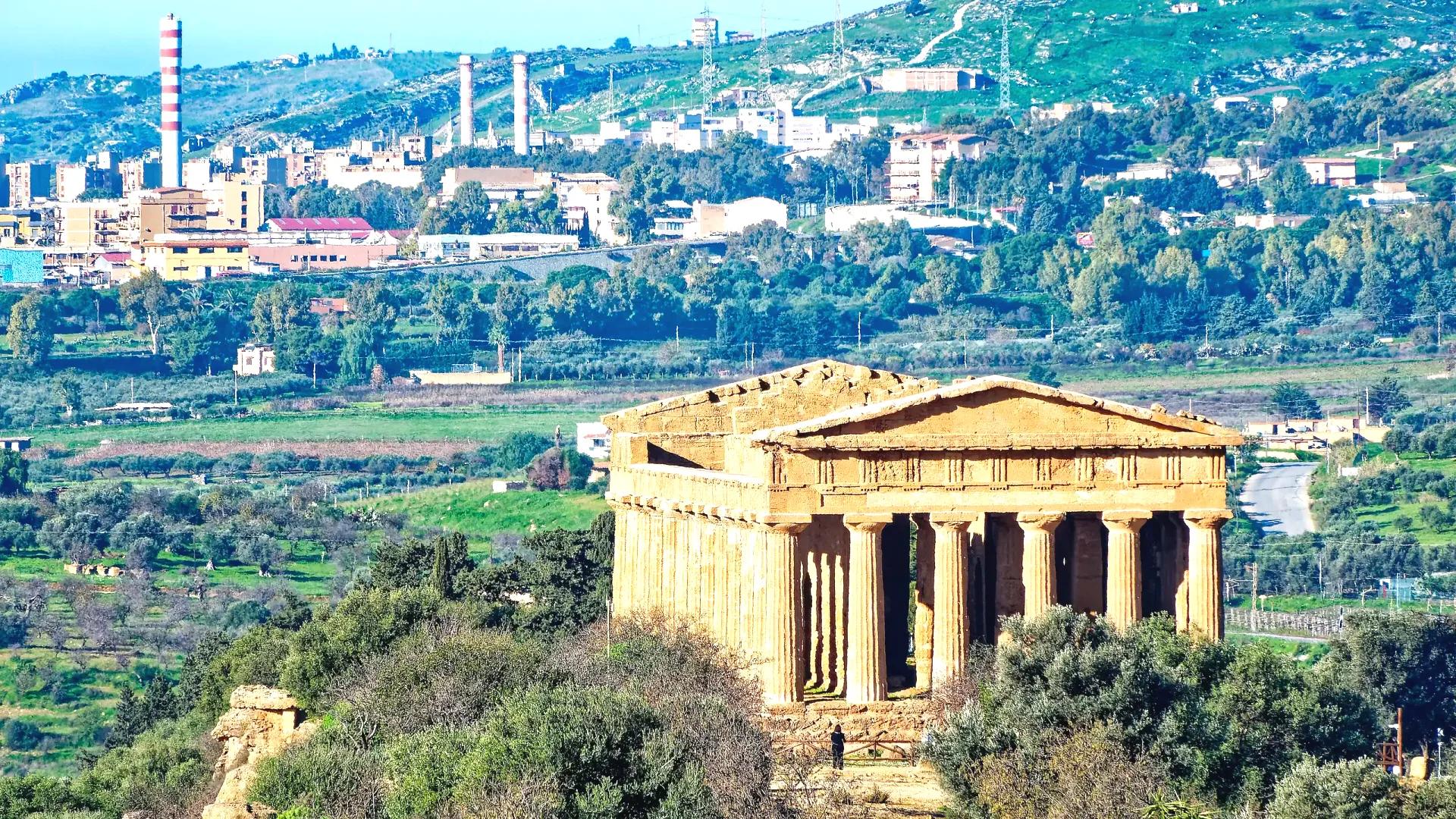
Use that first Agrigento evening for the temples — in reverse of the usual instinct. In the summer night season, enter in the early evening, walk the ridge through sunset, and meet the Concordia for the first time floodlit against a violet sky. Seeing the valley by night before you see it by day is a deliberate trick of sequencing: the illuminated temples imprint as pure theatre, and the next morning's walk then fills in the archaeology. Outside the night season, take the town instead — the passeggiata along the Via Atenea, dinner in the historic centre, and the view of the lit ridge from the belvederes above the valley.
Travelling without a car changes the shape but not the plan. Direct regional buses link Palermo with Agrigento in roughly the same two hours, and the city bus runs from Agrigento down to the Porta V entrance of the park. The interior legs further east are where a car earns its keep; carless travellers usually run Palermo–Agrigento–Palermo or continue to Catania by bus, and our transport guide covers the connections in detail.
Day four: the full Agrigento day
Morning belongs to the ridge. Be at the Porta Giunone gate for the 08:30 opening and walk east to west, downhill, in the young light: the Temple of Juno on its height, the intact colonnade of the Concordia, the fallen giants of the Olympieion, the four columns of Castor and Pollux. Before leaving the western zone, drop into the Kolymbethra Garden in the hollow below — the FAI-managed grove of citrus and ancient olives on the site of the Greek city's fifth-century BCE water basin, a separate small admission and worth every minute of the hour it takes. Exit at Porta V before the heat arrives in earnest.
Midday is for the museum and the table. The Museo Archeologico Regionale Pietro Griffo, open daily 09:00 to 19:00 on the hill between the park and the town, holds the reassembled eight-metre Telamon from the Temple of Olympian Zeus, the Ephebe of Agrigento and the painted vases of the Greek necropoleis — give it ninety minutes. Then a long Sicilian lunch in the historic centre, which is not lost time but the load-bearing wall of the whole day's architecture: you are indoors and fed through precisely the hours when the ridge is at its worst.
Late afternoon, drive the fifteen to twenty-five minutes west to Scala dei Turchi, the staircase of white marl that shelves into a turquoise sea at Realmonte. Know before you go that access has changed: after years of closure the cliff reopened under a managed-entry system, with visitor passes, timed slots of about an hour, capped numbers per slot, a designated access zone, and automatic closures in bad weather — climbing freely over the marl is finished, and summer slots reward booking ahead. The compensation is a calmer, protected site; and the classic profile view of the whole gleaming staircase, from the belvedere and the adjacent beach, remains gloriously unrestricted. Time it for the golden hour and let the day end there, white cliff, low sun, blue sea.
Days five to seven: the road east
From Agrigento the route bends northeast into the interior, and the natural first stop is the Villa Romana del Casale outside Piazza Armerina — around an hour and a half to two hours' drive. The villa is the second UNESCO World Heritage property of this route's middle days, inscribed in 1997 like Agrigento: a fourth-century CE Roman country palace whose floors carry some 3,500 square metres of mosaics, the finest surviving in situ anywhere in the Roman world — hunting scenes, sea-monsters, the famously gymnastic girls in their two-piece athletic wear. Two hours inside is the sensible allocation; it pairs with the temples of the previous day as antiquity's other register, private luxury after public piety.
Push on to Syracuse for two nights. The drive from Piazza Armerina takes roughly two hours, and Syracuse — Greek Sicily's other superpower, and once the rival of Akragas itself — closes the classical circle: the archaeological park with its vast Greek theatre and the Ear of Dionysius quarry, and the island heart of Ortigia with the Duomo built directly inside a Doric temple, its ancient columns still standing in the cathedral walls. After Agrigento's ridge, Ortigia's temple-turned-cathedral lands with particular force: it is the Concordia's survival story told again, this time from the inside.
End at Catania, under Etna, for the final night and the flight out — or stretch the route with an Etna excursion or a coastal day northward if the calendar allows. The through-line of the whole week is deliberate: Palermo's Norman-Arab palimpsest, Akragas at its Greek zenith, Rome at leisure in the villa, Syracuse from Greek theatre to baroque piazza. Sicily layered in the correct order, with the Valley of the Temples given the evening and the morning that the drive-through crowd never sees.
Compressed, reversed and carless variants
With exactly one week, the shape is: Palermo two nights, Agrigento one, Syracuse two, Catania one, flying into Palermo and out of Catania. The single Agrigento night still buys the entire core — summer evening or first-light morning on the ridge, Kolymbethra, museum, and Scala dei Turchi if you manage the afternoon tightly. With ten days, add a second Agrigento night (which relaxes the big day and lets you do both the evening and the morning visit), a night at Piazza Armerina or in the interior, and an extra day at either end. With five, sacrifice the villa before you sacrifice the Agrigento overnight.
The route reverses cleanly for Catania arrivals: Catania or Syracuse first, the villa, then Agrigento — where the reversed direction actually improves the temple day, since you arrive positioned for an evening visit and leave after a morning one — and Palermo to finish. If you fly in and out of Catania, run the loop Catania–Syracuse–Piazza Armerina–Agrigento–Palermo–Catania, accepting one longer transfer on the final day, or drop Palermo and keep the southeast leisurely.
A word on driving pace, because it is where Sicily itineraries quietly come apart. Sicilian road distances are honest but Sicilian road time is not: the map says two hours, and the map has not met the roadworks outside Caltanissetta, the tractor on the state road, or the twenty minutes spent finding parking in a hill town at lunchtime. Budget the day around one major site plus one drive, never two of each, and treat any leg over two and a half hours as the day's main event. The itineraries above are built to that rule — it is why the villa gets its own travel day rather than being bolted onto the Agrigento morning, and why the temples get an evening and a morning instead of a heroic single afternoon.
Whichever variant you run, book the fixed-capacity pieces before the flexible ones. In high summer that means the Scala dei Turchi timed slot and any guided evening visit at the temples first, accommodation second, and the freely walkable sites arranged around them. And match the season to the plan: May, June, September and October give this route its best weather-to-crowd ratio; July and August work beautifully precisely because of the night openings, provided you respect the afternoon; winter trades the evening act for a quiet, cool, short-day ridge — and early February scatters almond blossom through the whole valley. Our month-by-month guide takes that decision apart properly.
Frequently asked
How many nights do I need in Agrigento?
One well-planned night captures the core: an evening or floodlit visit, the 08:30 morning ridge walk, the Kolymbethra Garden, the archaeological museum and Scala dei Turchi. Two nights relax the schedule and let you do both the evening and the morning visit to the temples.
Is Agrigento on the way between Palermo and Catania?
Effectively yes. It sits at the midpoint of the southern coast, around two hours from Palermo, with the eastward continuation through Piazza Armerina to Syracuse and Catania forming a natural progression — an overnight there is a route decision, not a detour.
Can I do this itinerary without a car?
The Palermo–Agrigento leg works well by direct regional bus, and Agrigento's city bus serves the park's Porta V entrance. The interior stops — above all the Villa Romana del Casale — are far easier with a car; carless travellers usually simplify the eastern half or connect Agrigento to Catania by bus.
Do I need to book Scala dei Turchi in advance?
In summer, yes. The cliff reopened under a managed-entry system with visitor passes, timed slots of about an hour and capped numbers, and slots go quickly in peak season. The panoramic view from the belvedere and adjacent beach remains freely accessible if you miss out.
When is the best time of year to run this route?
May, June, September and October offer the best balance of weather and crowds. July and August work well if you plan around the heat — the summer night openings at the temples are a genuine advantage — and early February brings the almond blossom to the valley.