 Skip-the-line available
 Why the Temple of Concordia Survived When Every Other Temple Fell
A sixth-century bishop, a misapplied Roman inscription and twenty-four centuries of continuous use — the real story behind the best-preserved Doric temple outside Athens.
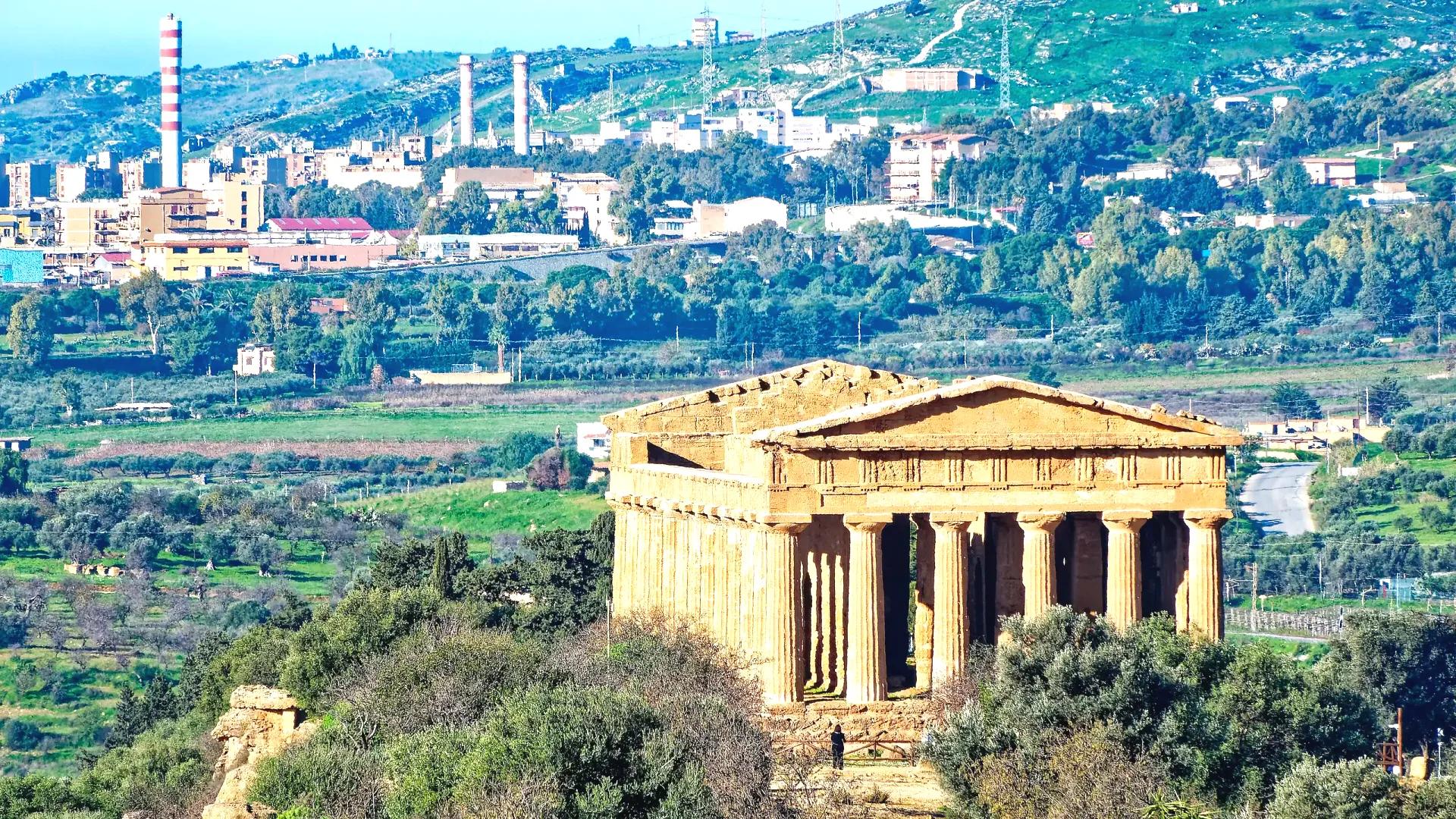
Of the great Doric temples that the Greek city of Akragas raised along its southern ridge, exactly one still stands substantially as its builders left it. The Temple of Concordia keeps its complete colonnade of thirty-four columns, its architraves and both pediments, and is routinely described as the best-preserved Doric temple in the world after the Parthenon. This was not geological luck. Its neighbours a few hundred metres away were shaken down by the same earthquakes and picked apart by the same quarrymen; the Temple of Juno burned in the same siege. The Concordia survived because of one very specific decision, taken by a bishop at the end of the sixth century CE, that turned a pagan temple into something too useful to demolish. This guide tells that story properly — what the building was, what ruined everything around it, and what to look for on the stone when you stand in front of it.
Built in the confident decades of Akragas
The temple went up around 440 to 430 BCE, in the generation when Akragas had money and reasons to spend it. The city had been founded around 582 BCE by Greek colonists from Gela, with settler roots reaching back to Rhodes and Crete, and within a century it had grown into one of the leading cities of the Greek Mediterranean — rich on grain, olives, horses and trade with the African coast opposite. Pindar, writing around 490 BCE for a flute-player from the city who had won at the Pythian Games, addressed Akragas as the most beautiful city of mortals. The ridge of temples was that wealth made permanent: a skyline of sanctuaries facing the sea, announcing the city to every ship that passed.
The building itself is a textbook of mature Doric architecture, raised within a decade or two of the Parthenon. The stylobate — the platform the columns stand on — measures 39.42 by 16.92 metres; the peristyle runs six columns across the fronts and thirteen down the flanks; each column rises about six metres, cut with twenty flutes, carrying the structure to a height of 8.93 metres. The proportions are the reason architects still make the pilgrimage: this is the Doric order at its point of balance, after the heaviness of the archaic temples and before the order stiffened into formula. Seen from the Via Sacra with the light raking across the flutes, the whole building reads as a single carved object.
One thing the temple is not is a temple of Concordia. The name is a convention, borrowed in later centuries from a Roman-era Latin inscription invoking the concord of the people of Agrigentum that was found in the vicinity and has nothing to do with the building. Which god or goddess the Akragantines actually built it for is unknown — the dedication is lost, as it is for most of the temples on the ridge, which is why archaeologists hedge the names of nearly all of them. The misnomer stuck because the building survived to need a name; its ruined neighbours borrowed theirs from antiquarian guesswork in the same way.
406 BCE and the slow ruin of everything else
The temple was barely a generation old when the city's golden age ended. In 406 BCE a Carthaginian army besieged and sacked Akragas; the Temple of Juno, on the height at the eastern end of the ridge, was burned in that catastrophe. The city was resettled and lived on through Hellenistic and Roman centuries, but it never again commanded the wealth that had built the sanctuaries, and buildings that expensive need exactly that wealth to maintain. The ridge of temples entered the long afterlife of all ancient monuments: standing, weathering, waiting.
What actually destroys Greek temples is rarely a single dramatic event. Earthquakes in late antiquity brought down colonnades that fire had weakened, and the enormous Temple of Olympian Zeus — never even finished after the 406 BCE conquest halted work — collapsed into a field of blocks. Then came the quieter, more thorough destroyer: reuse. A fallen temple is a quarry of perfectly dressed stone, and the Olympieion was mined for centuries, its blocks carted off for building projects in Agrigento and, in the eighteenth century, for the harbour works at Porto Empedocle down on the coast. Stone by stone, the largest Doric temple ever attempted became other people's walls.
Across the Mediterranean, the handful of ancient temples that survive nearly whole share one biography: they never stopped being used. The Parthenon endured as church and mosque; the temples of Syracuse and Athens that still stand were absorbed into cathedrals and city fabric. Usefulness bought maintenance — a roof kept in repair, walls kept plumb, vegetation kept out of the joints — and maintenance, sustained over centuries, is the entire difference between the Concordia and the Olympieion. At Agrigento you can test the rule in a single afternoon's walk: the temple that became a basilica stands complete; the temple that became a quarry is a debris field.
The bishop who walled in the columns
The decisive intervention came at the end of the sixth century CE, when Gregory, bishop of Agrigento, converted the temple into a Christian basilica dedicated to the apostles Peter and Paul. It was a common enough policy in that era — consecrating pagan sanctuaries rather than levelling them — but at Agrigento it was applied to the one temple on the ridge still complete enough to be worth converting, and the effect was to freeze the building at that moment of completeness for the next twelve centuries.
The conversion physically transformed the building. The open spaces between the columns of the peristyle were walled up, turning the colonnade into the outer shell of a church. The walls of the cella — the enclosed inner chamber where the cult statue had stood — were cut through with a series of arched openings, converting the Greek interior into a Christian nave flanked by aisles. A building designed to be walked around became a building to be gathered inside. Architecturally it was a mutilation; structurally it was a gift. The infill walls braced the colonnade against earthquakes, and the congregation kept a roof on it.
From that point the temple's survival was simply the ordinary life of a parish church: repairs after storms, re-plastering, generations of use. While the Olympieion was being carted away block by block a few hundred metres to the west, the Concordia was swept, roofed and prayed in. Preservation was not the intention — nobody in the twelfth century was curating Doric architecture — but it was the result. Almost everything you see standing today, from the full entablature to the tympana of the pediments, is there because for those twelve centuries the building was too busy being a church to fall down.
The eighteenth-century un-conversion
By the eighteenth century the travellers of the Grand Tour had rediscovered Sicily, and educated Europe developed an appetite for Greek architecture precisely as Greek architecture — not as the shell of a church. In 1785, in a restoration associated with the Prince of Torremuzza's antiquarian campaigns (some accounts date the start of work to 1788), the Christian alterations were stripped out: the infill walls between the columns came down and the building was returned, as nearly as possible, to its ancient form. It was one of the earliest deliberate monument restorations in Europe — the moment the Concordia stopped being a working building and became heritage.
The un-conversion could not be total, and the traces it left are now the most fascinating details on the site. Look at the long walls of the cella as you walk the flank of the temple: the row of arched openings cut by the sixth-century builders is still there, bright against the older masonry. The building carries both of its lives on its stone at once — Doric columns framing Byzantine arches — and once you know the story, the arches stop being a blemish and become the explanation. They are, quite literally, the reason there is still a temple to look at.
The modern chapter is recognition. The Concordia became the emblem of Agrigento and the centrepiece of the Archaeological Area of Agrigento, inscribed on the UNESCO World Heritage List in 1997 — a 934-hectare property covering the temples, the ancient walls and necropolises, and the agricultural landscape between them. UNESCO's description singles out the Doric temples as the demonstration of the ancient city's supremacy and pride, and much of the ancient town, it notes, still lies intact under the fields and orchards. The temple that a bishop saved by accident is now the image on half the book covers ever printed about Greek Sicily.
Standing in front of it: how to see the Concordia well
The Concordia sits at the midpoint of the classic east-to-west ridge walk, between the Temple of Juno and the Temple of Hercules, and how it looks depends enormously on when you arrive. In the first hour after the 08:30 opening the light is low, the tour groups are still at breakfast, and the eastern front catches the morning sun. In the last hours of the day the stone warms from honey to amber, and the western light rakes the flutes of the columns into deep relief. The dead centre of the day flattens it — photographically and emotionally — which is one more argument for the early or late visit that every Agrigento guide keeps making.
Give it twenty minutes at an absolute minimum, and walk the full circuit of the platform rather than stopping at the head-on view. From the north side you read the temple against the sea; from the south, against the ridge and the town above. Pause on the flank to find the basilica arches in the cella wall, and compare the state of this building with the burnt shell of Juno twenty minutes' walk east — the same architecture, the same ridge, the same earthquakes, separated only by the accident of a sixth-century consecration. That comparison, more than any single monument, is what the Valley of the Temples teaches.
In summer, consider meeting the temple twice. During the 2026 night season — 20 June to 20 September, with evening entry until 22:00 on weekdays and 23:00 on weekends — the Concordia is floodlit, and the transition hour when the sky goes violet behind the lit colonnade is the most photographed moment in Sicilian archaeology for good reason. Pair the site visit with the Pietro Griffo archaeological museum up the hill, open daily 09:00 to 19:00, where the model reconstructions and painted architectural fragments show you what the temple looked like when its stucco was white and its details were coloured — a genuinely startling correction to the romantic golden ruin outside.
Frequently asked
How old is the Temple of Concordia?
It was built around 440–430 BCE, making it roughly 2,450 years old — a close contemporary of the Parthenon in Athens.
Why is the Temple of Concordia so well preserved?
Because it never stopped being used. Around the end of the sixth century CE, Gregory, bishop of Agrigento, converted it into a Christian basilica dedicated to Peter and Paul. The infill walls braced the colonnade against earthquakes and twelve centuries of congregations kept it roofed and repaired, while the abandoned temples nearby collapsed or were quarried away.
Was it really dedicated to Concordia?
No. The name comes from a Roman-era Latin inscription about the concord of the people of Agrigentum found nearby, which has no connection to the building. The temple's actual dedication is unknown.
When were the church alterations removed?
In a restoration of 1785 — with some accounts dating the start of work to 1788, under the Prince of Torremuzza — the walls between the columns were removed and the temple returned to its ancient form. The arched openings cut into the cella walls for the basilica are still visible.
Is it really the best-preserved Doric temple after the Parthenon?
That is the standard assessment: it is the largest and best-preserved Doric temple in Sicily, and apart from the Parthenon it is generally considered the best-preserved Doric temple anywhere, with its full colonnade, entablature and both pediments intact.
When is the best time of day to see it?
The first hour after the 08:30 opening or the last hours of daylight, when low sun models the columns. In summer 2026 the park's night openings (20 June to 20 September) add a third option: the floodlit temple against the dusk sky.