 Skip-the-line available
 Which Entrance Should You Use at the Valley of the Temples?
Porta Giunone or Porta V — a concierge route guide to walking the ridge downhill, riding the electric shuttle, and pacing the Via Sacra in the Sicilian heat.
The most consequential decision you make at the Valley of the Temples is not which month to come or how long to stay — it is which of the two gates you walk in through. The archaeological park spreads across roughly 1,300 hectares of ridge and terraced hillside, but its five headline temples stand in a line along about 1.3 kilometres of the Via Sacra, and that line is not flat. Enter at the wrong end and you climb it in full sun; enter at the right end and the whole walk unrolls gently downhill with the Mediterranean in front of you. This guide explains how the two entrances — Porta Giunone in the east and Porta V, also signed Porta Quinta or Sant'Anna, in the west — actually work: where the car parks and bus stops are, how the electric shuttle inside the park fits into a route, and how to sequence the walk when the temperature climbs.
Two gates, one ridge: the geography that decides your route
The name Valley of the Temples is a charming piece of mislabelling. The temples do not sit in a valley at all: they occupy the crest of a long ridge that runs between the modern town of Agrigento, stacked on the hills above, and the coastal plain that slopes down to the sea. The ancient Greeks of Akragas built their sanctuaries along this crest deliberately, so that sailors approaching the coast would see a skyline of temples. That decision, made twenty-five centuries ago, is why your choice of entrance matters today: any walk through the park's core is a walk along a ridge line with real changes in elevation, in a landscape with very little shade.
There are two public entrances with ticket offices. The eastern one, Porta Giunone, sits on the Via Panoramica dei Templi beside the Temple of Juno, at the highest point of the ridge, and has its own car park. The western one, Porta Quinta — universally shortened to Porta V, and signed for the Sant'Anna district — is on Via Caduti di Marzabotto at the lower end of the site, with car and camper parking and the stop for the city bus. If you arrive by urban bus, the stop to ask for is Clinica Sant'Anna. Tour coaches are directed to a separate park-and-ride area at Contrada Cugno Vela in Villaseta, so independent visitors and groups largely arrive at different doors.
Be honest with yourself about distances before you choose. Gate to gate along the main spine is about 1.3 kilometres, but that figure is the straight run of the Via Sacra; once you add the loops out to each temple platform, the viewpoints over the ancient walls, and the crossing between the eastern and western zones — linked in part by a pedestrian footbridge — a normal visit involves 2.5 to 3 kilometres of actual walking and two to three hours on your feet. There is no obligation to walk back the way you came: the sensible pattern at Agrigento is a one-way traverse, entering at one gate and leaving by the other.
The case for Porta Giunone: downhill with the light behind you
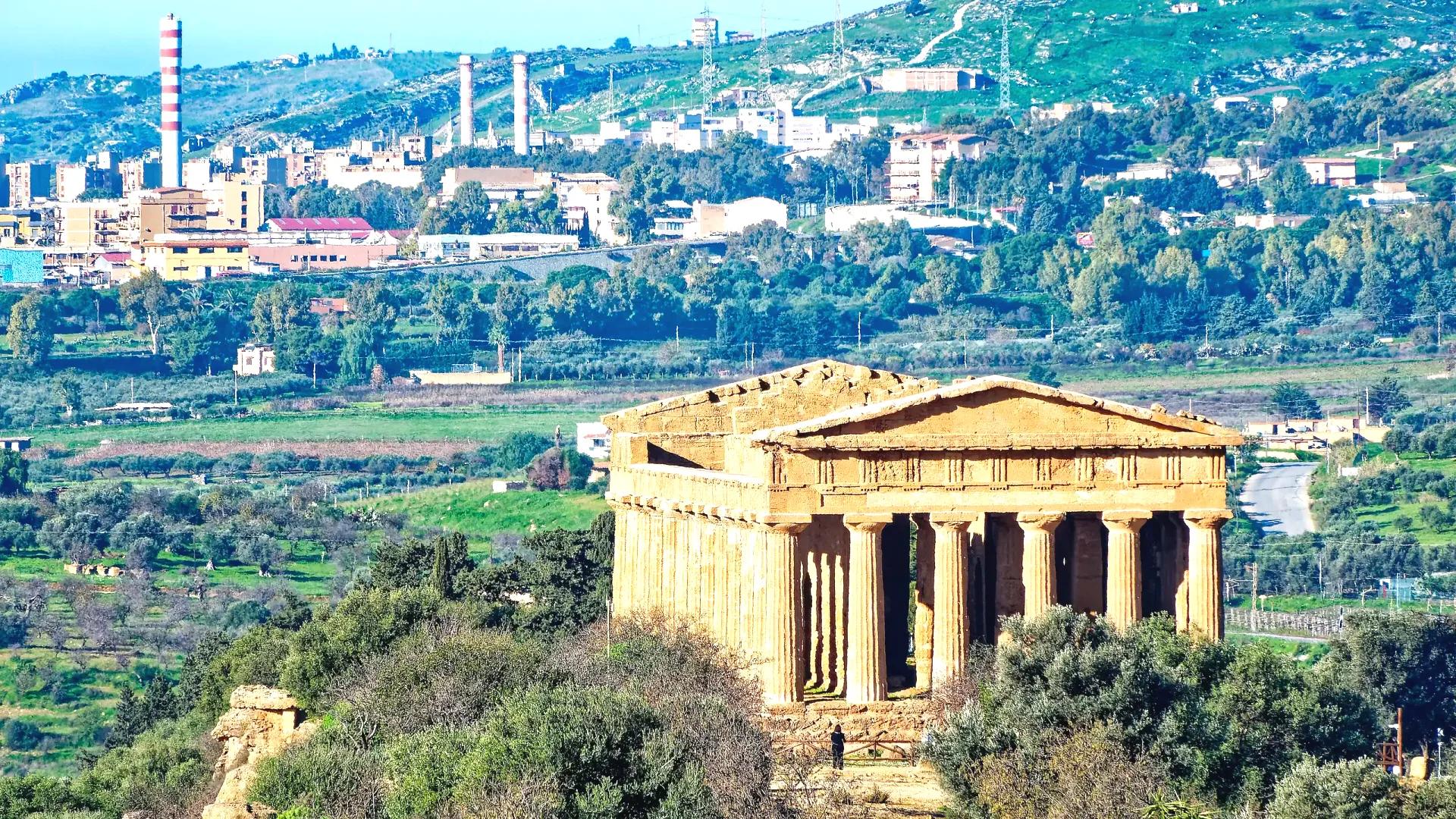
For a first visit, arriving by car or taxi, the default recommendation is simple: start at Porta Giunone when the gates open at 08:30 and walk west. The logic is threefold. The Temple of Juno stands on the easternmost and highest spur of the ridge, so beginning there means every subsequent metre trends downhill. The morning sun rises behind you, lighting the honey-coloured stone of each temple as you approach it rather than silhouetting it against glare. And the sequence builds properly: you open with the panoramic sweep of the whole valley from Juno's terrace, reach the magnificently intact Temple of Concordia while the light is still low and the crowds thin, and finish among the colossal ruins of the western zone.
The east-to-west running order is worth knowing in advance. From the Temple of Juno — built around 450 BCE and burnt by the Carthaginians in 406 BCE, the scorch of that siege still part of its story — the Via Sacra descends to the Temple of Concordia, the best-preserved Doric temple in Sicily and the reason most people come. Beyond it stands the Temple of Hercules, the oldest on the ridge, dating to the late sixth century BCE, with a line of eight re-erected columns. The path then passes into the western zone: the vast toppled platform of the Temple of Olympian Zeus with its famous stone giants, and finally the four slender columns of the Temple of Castor and Pollux, the postcard emblem of Agrigento.
The only complication of a one-way walk is getting back to your car, and it is a small one. If you parked at the Porta Giunone car park, exit at Porta V and take a taxi back around the outside of the park — a ride of five to ten minutes — or use the shuttle inside the park to return along the ridge to the eastern gate. If someone is driving you, the day becomes even simpler: be dropped at Porta Giunone in the morning and collected at Porta V when you emerge. Concierge itineraries for Agrigento are almost always built around exactly this drop-east, collect-west pattern.
When Porta V is the smarter start
Porta V earns its place as the right starting gate in several specific situations. If you arrive by city bus, it is simply your entrance — the Clinica Sant'Anna stop is at that end, and there is no equivalent service to the eastern gate. If you are travelling by campervan, the camper parking is at Porta V. And if your accommodation is on the coastal side of Agrigento, the western gate may be materially closer than the long loop up the Via Panoramica. None of these reasons should make you feel short-changed: the temples are the same temples in both directions.
The honest drawback of a west-to-east walk is the gradient. From Porta V the route climbs steadily toward the Temple of Juno, and on a July morning that climb is work. There are two well-tested fixes. The first is timing: enter at 08:30 sharp, take the western zone — Castor and Pollux, the Kolymbethra hollow, the Olympian Zeus platform — while you are fresh, and be on the higher eastern stretch before the heat peaks. The second is to use the shuttle in your favour: ride it from the Porta V end up to the Temple of Juno first, then walk the whole ridge back downhill to the gate you entered by. That converts Porta V into a downhill day just as effectively as starting at Porta Giunone.
There is also a photographer's argument for the west-to-east direction in the late afternoon. As the sun drops toward the sea, its light comes from the west; walking eastward puts that low golden light behind you, flooding the columns ahead. Visitors coming for the last hours of the day, or for the summer evening openings, often do best entering at Porta V, catching the Temple of Concordia in full sunset colour, and finishing on Juno's high terrace as the floodlights come up — the reverse of the classic morning route, for exactly the same reason of light.
The shuttle inside the park: how it works and when to use it
An electric shuttle runs the length of the site, linking the Porta V end with stops near the Temple of Hercules, the Temple of Concordia, the café area by the Arcosolia, and the Temple of Juno. It is a separate small supplement rather than part of the entry ticket, and it exists precisely because the park is long, hot and one-directional. Frequency and running hours vary with the season, so confirm the day's service at the ticket office when you enter rather than planning around a fixed timetable.
Used well, the shuttle solves three problems. It converts an uphill start into a downhill walk, as described above — ride to the top, walk back. It rescues a flagging party mid-route: if the heat catches up with you at the Concordia, you can ride the rest of the ridge instead of abandoning it. And it matters enormously for visitors with limited mobility, for whom the 1.3-kilometre gravel spine would otherwise be the difference between seeing the temples and seeing photographs of them; the stops put each of the headline monuments within a short, mostly level walk.
Equally, know when to skip it. From October to April the ridge walk is genuinely pleasant — the whole point of the site is the procession along the Via Sacra, with the almond and olive terraces falling away on either side and each temple revealing itself in sequence. The landscape between the monuments is not filler: it is part of what UNESCO inscribed in 1997, a 934-hectare World Heritage property in which the agricultural land, the ancient walls and the necropolises count as much as the colonnades. On a cool morning, walking every metre of it is the better visit.
Heat, water and pacing the walk
Shade is the scarcest resource on the ridge. The crest is open to the sky for almost its entire length, and from late June to early September the middle of the day is punishing. The park's own answer is its hours: gates open at 08:30 year-round, and in summer 2026 the site announced night openings from 20 June to 20 September, with entry until 22:00 on weekdays and 23:00 on weekends. The professional pattern is to walk the ridge in the first two hours after opening or in the last hours before sunset, and to be somewhere air-conditioned — the archaeological museum is the classic choice — between noon and four.
Carry more water than feels necessary; a litre per person for the ridge walk is not excessive in summer. The café near the Temple of Concordia, by the Arcosolia stretch of the ancient fortifications, is the practical midpoint for shade, cold drinks and a pause. Closed, comfortable shoes matter more than most visitors expect — the Via Sacra is compacted limestone and gravel, uneven in stretches, and the temple platforms themselves are worn stone. Sandals survive the walk; ankles are happier in trainers.
As a planning summary: a fast, temple-focused traverse takes two hours; a proper visit with the viewpoints and the western zone takes three. Add roughly an hour if you descend into the Kolymbethra Garden, the FAI-managed citrus hollow below the Temple of Castor and Pollux at the western end, which carries its own small admission on top of the park ticket and closes earlier than the park itself. Whichever gate you start from, know your exit time: outside the summer season, daytime entry runs to 19:00 with the site clearing by 20:00, and the last stretch back to either gate is longer than it looks on the map.
Frequently asked
Which entrance is best for a first visit?
Porta Giunone, the eastern gate, at 08:30 opening. Starting beside the Temple of Juno at the highest point means the entire 1.3-kilometre walk along the Via Sacra runs gently downhill, with the morning light on the temples as you reach them.
Can I enter at one gate and exit at the other?
Yes — the one-way traverse is the standard way to visit. Enter at Porta Giunone, exit at Porta V (or the reverse), then return to your starting point by taxi around the outside of the park or by the shuttle along the ridge.
Where do I get off the city bus for the Valley of the Temples?
At the Clinica Sant'Anna stop, which serves the Porta V entrance on Via Caduti di Marzabotto. The city bus does not serve the eastern Porta Giunone gate.
Is there parking at both entrances?
Yes. Porta Giunone has a car park on the Via Panoramica dei Templi; Porta V has parking for cars and campers. Tour coaches use a separate area at Contrada Cugno Vela in Villaseta. Do not park on the approach roads — it is enforced.
How far is the walk between the two gates?
About 1.3 kilometres along the main spine, but a realistic visit covers 2.5 to 3 kilometres once you include the temple platforms and viewpoints. Allow two to three hours, plus about an hour if you add the Kolymbethra Garden.
Is the route manageable with limited mobility?
The spine path is compacted gravel with slopes and uneven stretches, but the electric shuttle stops near each of the headline temples, which brings most of the site within short, mostly level walks. Confirm the day's shuttle service at the ticket office when you arrive.