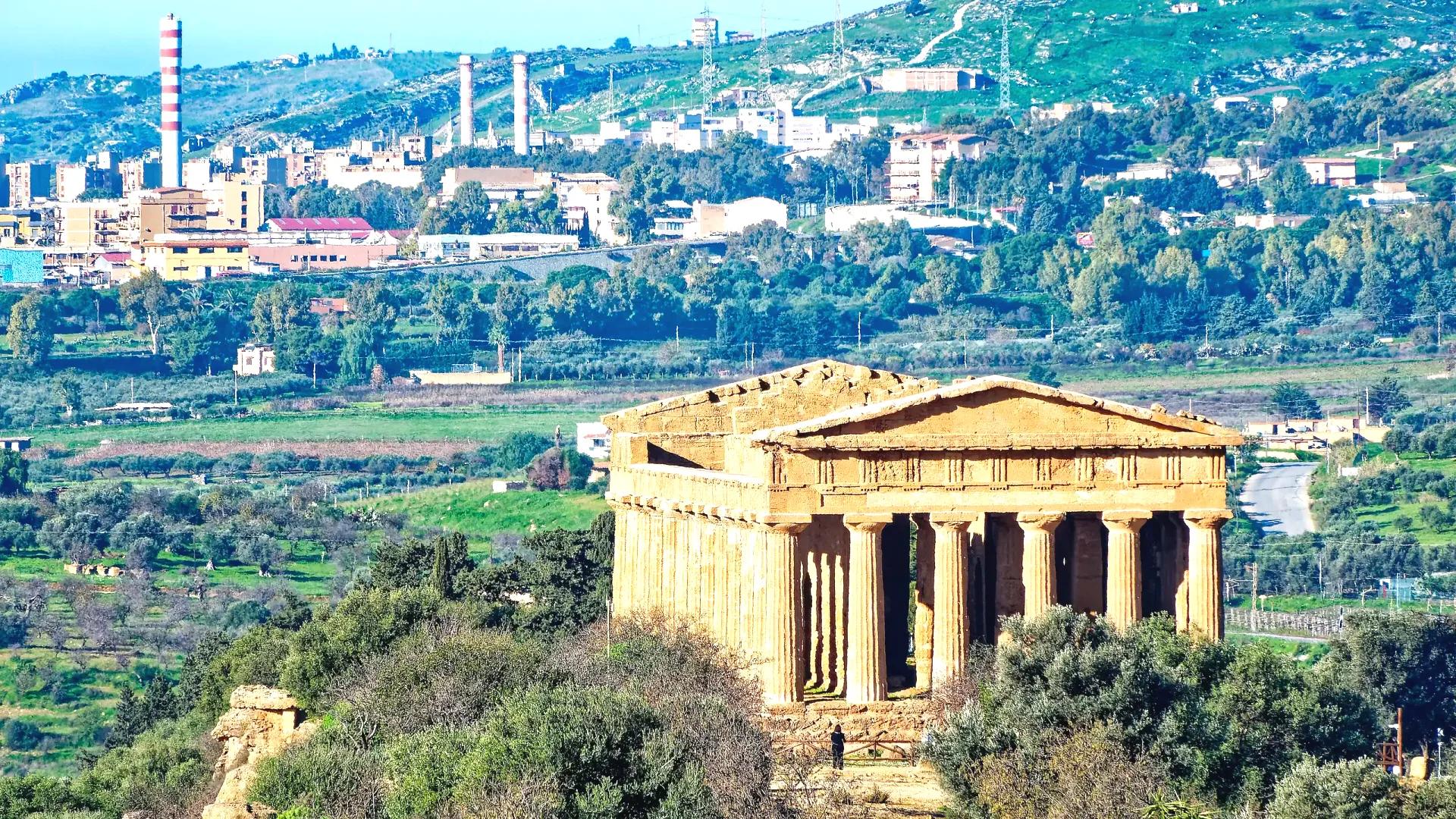
Sacred Way path between the Temple of Juno and Temple of Concordia, Agrigento

The Valley of the Temples in One Day: A Practical Itinerary

A concierge-built hour-by-hour plan to walk the Sacred Way, see the Telamon at the archaeological museum, and add an afternoon at Scala dei Turchi.

Updated May 2026 · Valley of the Temples Tickets Concierge Team

A well-paced day at the Valley of the Temples is a real pleasure, but a badly-paced day is exhausting. The archaeological park is dispersed across roughly 1,300 hectares of rolling ridge, the main temples are spread along 1.3 kilometres of Sacred Way, and the supporting cast — the Pietro Griffo archaeological museum, Casa Pirandello, the white-marl cliffs of Scala dei Turchi — sits a short drive away. The pattern that works for most first-time visitors is: enter the park early in the morning at the eastern Porta Giunone gate, walk westward along the ridge past five major temples, exit at Porta V, recover with a long Sicilian lunch in town, then visit the museum (for the giant Telamon) in the early afternoon and end the day at Scala dei Turchi for sunset.

Morning: enter Porta Giunone at opening, walk the Sacred Way

Aim to arrive at Porta Giunone, the eastern entrance, at 08:30 — the park's standard opening time. This is the perfect starting point for an east-to-west walk because the Temple of Juno, perched on the easternmost rocky spur of the ridge, catches the morning light first. The temple was built around 450 BCE, sits at the highest point of the Hill of the Temples, and gives you the entire valley spread out below before you walk through it. Take fifteen minutes here, photograph the eastern colonnade with the sea behind it, then begin walking westward along the Via Sacra.

After the Temple of Juno the path descends gently to the Temple of Concordia, the centrepiece of any visit and one of the best-preserved Greek temples anywhere in the Mediterranean. The Concordia was built around 430 BCE in the Doric peripteral style, with six columns on the short sides and thirteen on the long sides. Its survival is largely owed to its conversion into a Christian basilica in the 6th century CE, which protected it from the systematic quarrying that destroyed most ancient temples. The early-morning light, particularly in spring and autumn, throws the columns into deep relief; allow at least twenty minutes here.

Continue west to the Temple of Hercules, the oldest of the Doric temples on the ridge (late 6th century BCE), now mostly fallen but with eight reconstructed columns standing in line — an evocative reminder of what the others looked like before the earthquakes. Beyond Hercules the path crosses under the modern Via dei Templi to the western temples: the colossal Temple of Olympian Zeus (Olympieion), and at the far western end the Temple of Castor and Pollux, the four reconstructed columns of which have become the symbol of Agrigento itself.

The Temple of Olympian Zeus and the lost giant

The Temple of Olympian Zeus is, in many ways, the most archaeologically interesting site in the entire valley, even though almost nothing of it stands today. When complete it was the largest Doric temple ever built — roughly 56 by 113 metres at the stylobate, with eight columns across the short ends and seventeen along the sides. It was begun after the Battle of Himera in 480 BCE, partly to commemorate the Akragantine victory over the Carthaginians, but it was never quite finished. An earthquake in late antiquity brought it down, and the stones were extensively reused in later Sicilian construction, including the harbour at Porto Empedocle.

The most distinctive architectural feature of the Olympieion was a series of colossal male figures, the Telamons, that were integrated into the upper part of the temple's external walls. Each Telamon was nearly eight metres tall, sculpted in the round, and appeared to be holding up the entablature of the temple on his shoulders. One Telamon was reassembled in 1825 by the Sicilian archaeologist Raffaello Politi from original fragments found on site, and is now displayed in the regional archaeological museum a short drive up the hill. A reconstructed full-size Telamon lies in the ruins of the temple itself, giving a sense of the original scale.

Allow about twenty minutes at the Olympieion. The site is not visually dramatic in the way the Concordia is, but if you read the brief information panels and walk slowly across the foundation platform, the scale of what was attempted in the 5th century BCE — and the scale of what was lost — becomes properly vivid.

Exit Porta V and visit the Pietro Griffo Museum

After the Temple of Castor and Pollux at the far western edge of the park, exit through Porta V. By this point — typically around 11:30 if you started promptly at 08:30 — you will have walked about 1.3 kilometres along the ridge, photographed five major temples and spent enough time in direct sun to be ready for shade. If you prefer not to walk back, the internal shuttle returns you to either gate for a modest fee. Otherwise a short taxi from Porta V back into the historic centre takes five minutes.

The Museo Archeologico Regionale Pietro Griffo sits about a kilometre up the hill from the western temples, in the Contrada San Nicola, and is open continuously from 09:00 to 19:30 with last admission at 19:00. The museum holds the single most important artefact from the entire site: an original Telamon, reassembled in 1825 from fragments found at the Olympieion, standing nearly eight metres tall in the main hall. Even visitors who normally skip archaeological museums should make an exception here. Seeing the Telamon up close, after walking past the temple foundations earlier in the morning, completes the visit in a way that nothing else does.

The museum's other star pieces include the Ephebe of Agrigento (a 5th-century BCE marble youth), painted Greek vases from local necropoleis, and an extensive display of architectural fragments that explain how the temples were built and decorated. Allow ninety minutes if you read most of the panels, sixty minutes if you focus on the highlights. The museum sits in a beautifully landscaped enclave and the small cafe is a sensible lunch stop.

Late lunch and an early-afternoon pause in the historic centre

After the museum, climb the short distance up to the historic centre of Agrigento — the medieval and baroque town that sits on the ridge above the archaeological park. The Via Atenea is the main pedestrian artery, and a cluster of well-regarded restaurants serves classical Sicilian cuisine in the streets around it. A long lunch here is part of the rhythm of a proper Sicilian day; the heat of the early afternoon (especially in spring and autumn) makes it the right moment to be indoors with a glass of Grillo and a plate of pasta alle sarde or busiate al pesto trapanese.

If you have an extra ninety minutes and an interest in modern literature, the Casa Pirandello — birthplace of the Nobel-laureate playwright Luigi Pirandello — is in the village of Caos, on the coast about ten minutes' drive west of the historic centre. The house has been preserved as a small museum, with the writer's library, manuscripts and a windswept garden where his ashes were buried beneath a lone pine. It is a quiet, contemplative stop, not a major attraction, but it adds genuine depth to the southern-Sicilian context of the day.

Otherwise, simply wander. The cathedral of Agrigento sits at the highest point of the old town and offers a panoramic terrace over the temples below. Small artisan shops along the Via Atenea sell almond pastries, Sicilian ceramics from Caltagirone, and the regional sweets made from the same almond crop that fills the lower terraces of the temples with blossom every February.

Late afternoon: Scala dei Turchi and the sunset return

The final stop of the day, weather permitting, is Scala dei Turchi — the white-marl cliff that rises in a series of natural staircases out of the Mediterranean about fifteen minutes' drive west of Agrigento, in the comune of Realmonte. The rock is composed of pure white marl, a calcareous-clay sedimentary stone that the wind and rain have sculpted into smooth terraces. The contrast between the dazzling white cliff, the turquoise sea and the surrounding ochre coastline is one of the most photographed sights on Sicily.

Direct access to the cliff face itself has been restricted in recent years for conservation reasons, with fencing in place and signs prohibiting climbing on the marl. The view, however, remains unrestricted: a short walk along the adjacent public beach gives you the full cliff in profile, and the views from the small road above the bay are excellent. In summer the beach below the cliff is a popular swimming spot, with the gentle, shallow gradient of the seabed making it a favourite for families.

Time your arrival at Scala dei Turchi for ninety minutes before sunset. The west-facing aspect of the cliff means the marl turns a luminous warm white as the sun drops, and the sea behind it shifts through every shade of blue. After sunset, drive the fifteen minutes back into Agrigento for dinner in the historic centre. If you have only a single day in southern Sicily, this is how to spend it: temples in the morning, museum and lunch through midday, white cliffs and the Mediterranean at dusk.

Frequently asked

Can I really see the Valley of the Temples in one day?
Yes — comfortably, if you start at opening (08:30) and follow the east-to-west ridge walk. A standard concierge day combines the temples in the morning, the Pietro Griffo Museum and lunch through midday, and Scala dei Turchi or Casa Pirandello in the late afternoon.
Which entrance should I use for a one-day visit?
Enter at Porta Giunone (the eastern gate, near the Temple of Juno) and walk westward along the Sacred Way. This puts the morning light on the temples as you arrive and ends the walk at Porta V, near the western car park and the road up to the museum.
How long does the walk from Porta Giunone to Porta V take?
About 1.3 kilometres along the Sacred Way, with stops, typically two to three hours depending on how long you spend at each temple.
Is the Pietro Griffo Museum worth the extra time?
Yes. The reassembled original Telamon — nearly eight metres tall — is in the museum, and seeing it up close after standing on the foundations of the Olympian Zeus temple completes the visit. Allow at least an hour.
Can I climb on Scala dei Turchi?
Direct climbing on the marl cliff has been restricted in recent years for conservation reasons. The view from the adjacent beach and the road above remains spectacular and is unrestricted.
What if I am visiting in summer — does this itinerary still work?
Yes, with a heat adjustment. In July and August, enter the park at 08:30, exit by 11:30 before the worst of the heat, spend the entire midday inside the air-conditioned museum and a long lunch, and head to Scala dei Turchi (which gets a sea breeze) only after 16:30.
Are there any temples I have not mentioned?
The standard ridge walk covers the Temples of Juno, Concordia, Hercules, Olympian Zeus and the Dioscuri (Castor and Pollux). Smaller sanctuaries — Asclepius, the Tomb of Theron, the Sanctuary of the Chthonic Gods — sit slightly off-axis and reward a longer second visit if you have it.
How much walking is involved overall?
Roughly 3 to 4 kilometres of total walking through the day, including the ridge itself, the museum, the historic centre and Scala dei Turchi beach. Wear comfortable closed-toe shoes; the limestone gravel is uneven in places.
Is the itinerary suitable for children?
Yes, with shade and water planning. Children typically enjoy the Telamon at the museum and the white cliff at Scala dei Turchi as much as the temples themselves. Avoid the midday-summer walk on the ridge for younger children.